

Before you build strength, you need a foundation to build it upon.
Whether you’re a competitive athlete, recovering from an injury, living with a physical disability, or someone who has never picked up a dumbbell, I believe every exercise program should begin with an understanding and assessment of the inner core.
Unfortunately, this is one of the most overlooked aspects of exercise. Many people spend years strengthening their bodies without ever evaluating the muscles responsible for providing their internal stability.
What Is the Inner Core?
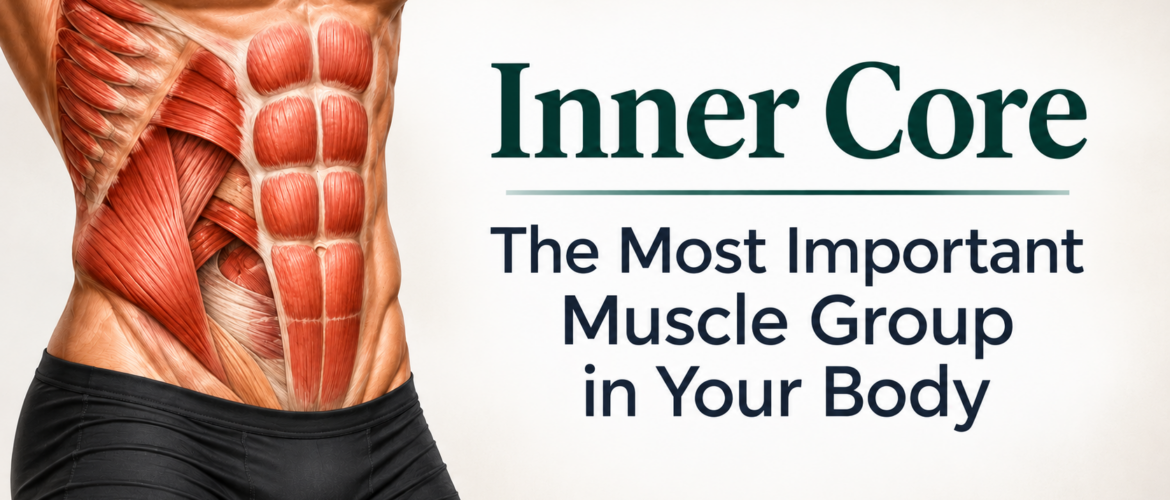
The inner core is your body’s deep internal stabilization system. It helps stabilize the spine, pelvis and trunk, providing a foundation from which the rest of your body can move.
The four primary muscle groups of the inner core are:
- Transverse Abdominis (TVA): Your deepest abdominal muscle, which wraps around your midsection like a natural corset.
- Diaphragm: Your primary breathing muscle, which also helps regulate intra-abdominal pressure and spinal stability.
- Multifidus: Deep spinal muscles that help control and stabilize individual segments of your spine.
- Pelvic Floor: The muscles forming the base of your abdominal cavity, supporting your pelvic organs and helping regulate pressure.
Visualize these muscles as an internal cylinder. The diaphragm forms the roof, the pelvic floor forms the bottom, the transverse abdominis wraps around the sides, and the multifidus provides support along the spine.
These muscles are designed to work together as an integrated system.
It’s Not Sexy
Unlike its counterpart, the outer core, the inner core gets very little attention in the beauty-driven fitness industry.
Six-pack abs sell products. Nobody walks around the gym showing off their transverse abdominis.
Whether we want to admit it or not, many people begin exercising because they want to look better. If a byproduct of looking better is feeling better, then great!
I would argue for reversing those priorities.
Train to feel better. Train to function better. Train to move better. Allow looking better to become a byproduct of those efforts.
Someone can have an impressive physique, visible six-pack abs and the ability to lift significant amounts of weight while still having difficulty coordinating their deep abdominal muscles.
Looking fit and functioning well are not necessarily the same thing.
Inner Core vs. Outer Core
Most people are familiar with the outer core, or at least know its general address. The rectus abdominis (your six-pack muscles), obliques and larger back muscles are among its more recognizable components.
These muscles help produce and control movement, generate force and stabilize the body under load.
The inner core specializes in deep internal stability and pressure regulation.
Think of the inner core as the foundation of a house and the outer core as the structure built upon it. Both are essential, and their functions overlap.
Imagine building a beautiful house on a foundation that hasn’t been properly evaluated. Adding another floor to that house doesn’t necessarily improve the integrity of its foundation.
The same principle applies to exercise. Adding more resistance to an existing movement dysfunction may simply make you stronger within that dysfunctional pattern.
You can become stronger at performing a movement without necessarily becoming better at performing it.
Stability Before Movement
One of the most fascinating aspects of the inner core is its relationship with the nervous system.
Before certain movements occur, your brain anticipates the forces that will be placed upon your body and recruits muscles to help manage those forces. This is known as feedforward or anticipatory muscular activation.
When you rapidly raise your arm, for example, your nervous system doesn’t simply recruit the muscles responsible for raising it. It also prepares your trunk to manage the resulting forces.
This largely happens without conscious thought.
Research has identified alterations in the recruitment and timing of deep trunk muscles in some people experiencing lower back pain.
Imagine having a group of incredibly strong employees who don’t show up to work when you need them. Their individual strength is of little benefit if their timing is off.
Your muscles operate under a similar principle.
Inner-core training is therefore as much about improving communication between your brain and muscles as it is about developing muscular strength.
Ultimately, we want these muscles to coordinate automatically, without having to consciously think about contracting them every time we move.
Could Your Inner Core Be Contributing to Your Injuries?
Where you experience pain is not necessarily where the problem originates.
Someone experiencing recurring shoulder pain may have difficulty stabilizing their trunk and shoulder girdle. Someone experiencing knee pain may struggle to control their pelvis during walking, running or squatting.
The body is an interconnected system. When one area isn’t functioning efficiently, another area may have to compensate.
When the inner core is not adequately meeting the demands of an activity, other muscles may take on additional stabilization responsibilities.
Under certain circumstances, this can contribute to excessive muscular tension, fatigue and altered distribution of forces throughout the body.
This is one reason why repeatedly stretching a tight muscle may provide temporary relief without addressing why it keeps tightening up.
Perhaps that muscle isn’t simply tight. Perhaps it’s working overtime to provide stability.
Does every injury originate from inner-core dysfunction? Absolutely not. Pain and injuries have numerous potential contributing factors. Pain itself can also alter muscular recruitment. However, assessing the body’s stabilization system is an important part of understanding the bigger picture.
For more on this subject, read my article, Why Your Workouts Aren’t Fixing Your Pain: The Missing Link Is Often Your Inner Core.
Breathing and Inner-Core Function
It’s impossible to have a comprehensive conversation about the inner core without discussing breathing.
During inhalation, your diaphragm contracts and descends. Your rib cage expands, and your abdominal wall and pelvic floor accommodate changes in pressure.
During exhalation, the diaphragm rises, and the abdominal musculature and pelvic floor coordinate according to the demands of the activity.
This relationship helps regulate something called intra-abdominal pressure, which contributes to spinal and trunk stability.
Think of a pressurized cylinder. Appropriate internal pressure helps the cylinder resist external forces. Your body utilizes a similar principle to assist in stabilizing the trunk.
Chronic stress, habitual shallow breathing, pain and excessive muscular tension can all influence this coordination.
This is why I assess breathing patterns regardless of whether someone comes to me for lower back pain, shoulder problems, athletic performance or general fitness.
Learning how to breathe efficiently and coordinate that breathing with muscular recruitment is an important part of establishing a functional inner core.
Are You Building Strength on the Right Foundation?
If you’re dealing with recurring injuries, muscular tension or limitations that aren’t improving despite your exercise efforts, it may be time to take a closer look at how your body functions.
Learning to Recruit Your Transverse Abdominis
One of the first exercises I introduce to many of my clients is something commonly referred to as a tummy vacuum, or abdominal drawing-in maneuver.
The purpose of this exercise is not to burn belly fat, shrink your waist or develop six-pack abs. It is a motor-control exercise designed to improve your awareness and recruitment of your deep abdominal musculature.
Although it appears incredibly simple, many people initially struggle with this exercise, regardless of their fitness level.
Some hold their breath. Others excessively recruit their outer abdominal muscles, tilt their pelvis, tense their shoulders or change the position of their spine.
The objective is to gently draw the abdominal wall inward without relying on these compensatory strategies.
Depending on the individual’s abilities, I may introduce this exercise in a lying, four-point kneeling, seated or standing position.
- Establish a comfortable, neutral spinal position.
- Relax your shoulders and maintain normal breathing.
- Gently draw your lower abdomen inward, as though you’re creating a little extra room between your stomach and your waistband.
- Maintain the contraction while continuing to breathe naturally.
- Release and repeat as instructed.
More effort is not necessarily better. The objective is muscular recruitment and coordination, not a maximal contraction.
If we’ve recently had our first session together, this is one of the reasons I’ve likely given you tummy vacuums as part of your homework.
These seemingly simple exercises are laying the groundwork for much of what we’ll be doing moving forward.
Why I Use a Blood Pressure Cuff
Another exercise I frequently introduce during an initial assessment involves placing a blood pressure cuff beneath the lower abdomen or lower back.
No, we’re not measuring your blood pressure!
We’re using the cuff as a pressure biofeedback device to provide measurable feedback about your ability to recruit your abdominal musculature and maintain control of your spine and pelvis.
When positioned beneath the lower abdomen, changes in pressure during an abdominal drawing-in maneuver can help us assess your ability to perform the movement without obvious compensations.
When positioned beneath the lower back, the cuff can provide feedback about your ability to maintain a desired spinal and pelvic position while moving your arms or legs.
It helps us identify movement strategies that might otherwise go unnoticed.
The cuff does not directly measure the strength or isolated activation of the transverse abdominis. Rather, it provides feedback that, combined with observation and other assessments, helps us evaluate and improve motor control.
As your control improves, we can gradually introduce more challenging movements.
Eventually, the objective is to maintain appropriate stability without relying on the cuff or consciously thinking about every muscle involved.
Tummy Vacuums vs. Abdominal Bracing
Learning to draw your abdomen inward does not mean you should walk around sucking in your stomach all day, nor does it mean you should perform every exercise that way.
Abdominal drawing-in and abdominal bracing are two different strategies.
- Abdominal drawing-in: A relatively low-intensity exercise used to develop awareness, recruitment and control of the deep abdominal musculature.
- Abdominal bracing: The coordinated contraction of multiple trunk muscles to increase stability and manage external forces.
The amount of muscular recruitment necessary to pick up a pencil is considerably different from what’s necessary to pick up a heavy piece of furniture.
A functional inner core should be capable of adapting to the demands placed upon it, rather than remaining excessively contracted throughout the day.
Just as important as learning how to contract these muscles is learning how to relax them appropriately.
This is particularly important when working with individuals who experience excessive abdominal tension, dysfunctional breathing patterns or pelvic floor issues.
Are You Training Your Muscles or Training Your Body?
One of my biggest concerns with conventional exercise programs is the emphasis placed on training individual muscles rather than teaching those muscles how to function together.
When you sit on a fixed-motion exercise machine, the machine often provides much of the external stability that your body would otherwise need to generate internally.
You can develop considerable muscular strength without necessarily placing significant demands on your body’s internal stabilization system.
While exercise machines and isolation exercises have their place, they should not automatically become the foundation of every exercise program.
Consider the difference between performing a seated machine chest press and performing a standing cable press. Both involve many of the same upper-body muscles, but the standing exercise generally places greater demands on balance, trunk stability and coordination throughout the body.
Life rarely asks us to use one muscle at a time. Walking, lifting, pushing, pulling, carrying and participating in sports all require communication and coordination between multiple muscle groups.
We isolate to educate. We integrate to make it functional.
This is precisely why we begin by teaching isolated recruitment of the inner core before progressively integrating that recruitment into more complex movements.
For a more comprehensive explanation, read my article, Why Integrated Exercises Build Real Strength (And Why Machines Often Miss the Mark).
From Stability to Strength
The ultimate goal of inner-core training is not to become exceptionally good at performing tummy vacuums.
The goal is to establish the muscular coordination and internal stability necessary to move more efficiently throughout your life.
Depending on an individual’s assessment, abilities and goals, an exercise program may progress through several stages:
- Awareness and recruitment: Learning to identify and recruit the appropriate muscles.
- Breathing and coordination: Learning to coordinate muscular recruitment with natural breathing.
- Static stability: Maintaining appropriate control of the spine and pelvis in different positions.
- Dynamic stability: Maintaining control as the arms, legs or trunk begin to move.
- Integrated movement: Incorporating stability into squatting, bending, pushing, pulling, twisting and walking.
- Progressive resistance: Gradually increasing the demands placed upon the body as its capacity improves.
- Power and performance: Developing the ability to manage greater forces, speeds and more complex movements when appropriate.
These stages can overlap, and not everyone needs to progress through them at the same rate.
The exercises, positions and resistance I select for a competitive athlete will likely look considerably different from those I select for someone recovering from an injury or living with a physical disability.
However, the underlying principles remain the same.
Before You Even Smell a Dumbbell
Whether your goal is to run a marathon, improve your golf game, build muscle, lose weight, get out of a chair without assistance or simply live with less pain, understanding your body’s foundational stabilization system should be a priority.
This doesn’t mean you need to master every inner-core exercise before participating in physical activity or resistance training.
It means your exercise program should take your current level of stability, coordination, mobility and physical capacity into consideration before determining what demands to place upon your body.
Exercise is a stressor. When appropriately prescribed, that stress encourages the body to adapt and become stronger. When poorly matched to your current abilities, it can exceed your body’s capacity to manage it.
More weight, more repetitions and more intensity aren’t always the answer.
Sometimes the most productive thing you can do is take the time to improve the quality of the movement before increasing the quantity or intensity.
This is one of the fundamental principles behind my approach to holistic fitness and corrective exercise.
Looking Beyond the Muscles
Of course, the inner core does not operate independently of the rest of the body or your lifestyle.
Sleep, stress, nutrition, breathing habits, previous injuries, posture and daily movement patterns can all influence your ability to move, recover and adapt to exercise.
Someone who is chronically stressed, sleep deprived and dealing with persistent pain may have very different exercise needs from someone who is well rested, recovering efficiently and experiencing minimal stress.
This is why I take a holistic approach to health and exercise rather than simply prescribing sets and repetitions.
We need to consider the environment in which we’re asking the body to function, recover and become stronger.
Build Your Body From the Inside Out
If you’re reading this following our initial session together, hopefully you now have a better understanding of why we spent time evaluating your posture, breathing, abdominal recruitment and movement patterns rather than immediately jumping into a conventional workout.
There is a purpose behind those seemingly simple exercises.
If you’re reading this because you’re dealing with recurring injuries, consider whether your body’s foundational stabilization system has ever been thoroughly assessed. It may be one of the missing pieces of the puzzle.
And if you’re reading this because you’re looking to become stronger, fitter or more athletic, remember that developing strength and developing the ability to manage that strength should go hand in hand.
Don’t just train your body to become stronger. Teach your body how to use that strength.
We only get one body. Let’s build it from the inside out.
Ready to Build a Better Foundation?
At Mind Body Fit, I develop individualized exercise and lifestyle programs based on your posture, movement patterns, injury history, physical abilities and personal goals.
Whether you’re looking to address recurring pain, improve mobility, regain strength or enhance athletic performance, the first step is understanding how your body currently functions.
Private coaching is available in Lakewood Ranch, Bradenton and the surrounding Sarasota area, as well as virtually from anywhere.
This article is intended for educational purposes. Exercise recommendations should be individualized, particularly when working with an existing injury, medical condition or physical limitation.